

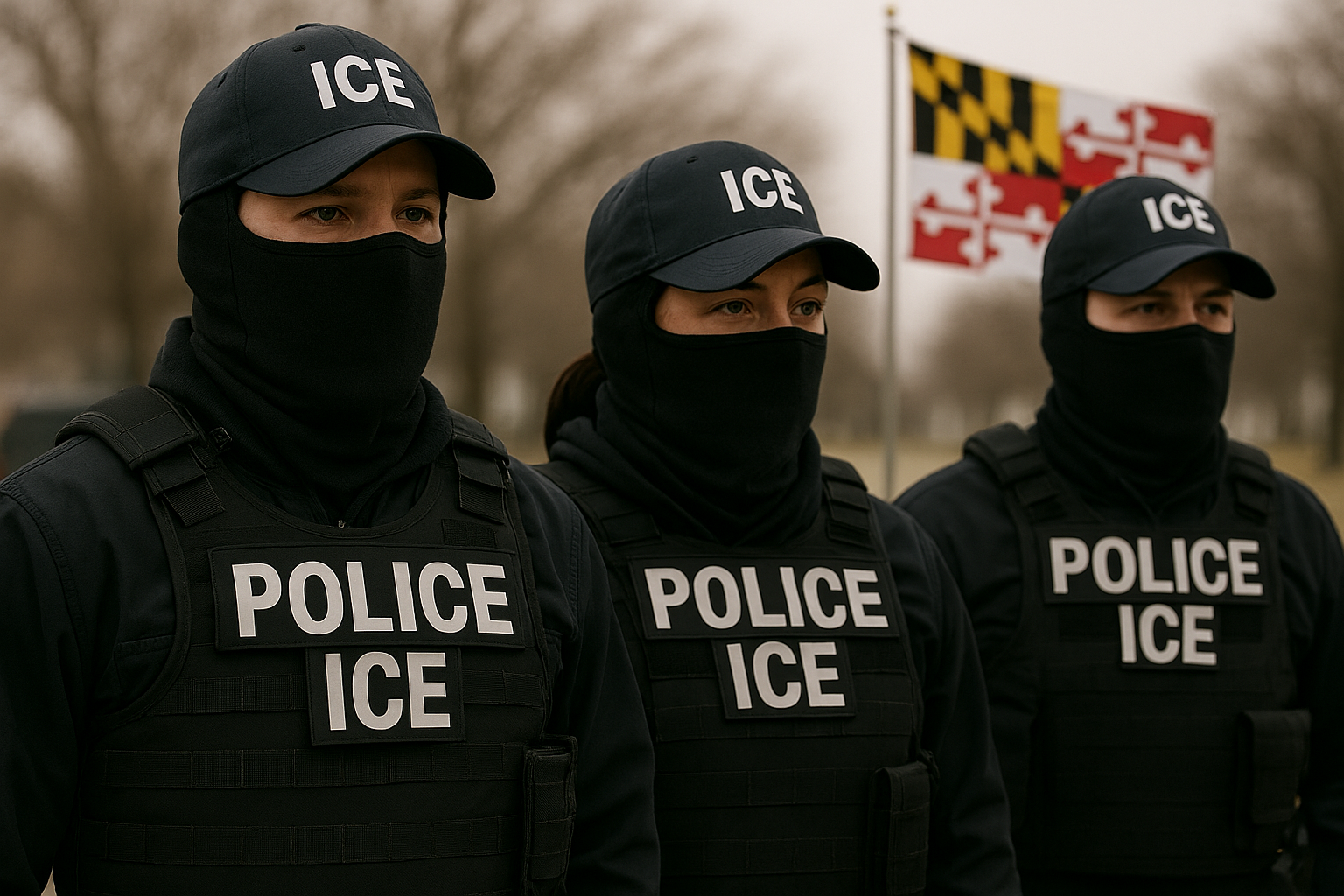
ANNAPOLIS — Maryland lawmakers have introduced a sweeping new proposal that would sharply restrict when law enforcement officers may cover their faces while on duty, marking one of the most significant police-transparency measures considered in recent years.
Senate Bill 1, pre-filed for the 2026 legislative session and backed by more than a dozen Democratic senators, would require the Maryland Police Training and Standards Commission to create a statewide model policy prohibiting officers from wearing opaque face coverings during the performance of their duties. All law enforcement agencies operating in the state — including federal, out-of-state, and local departments — would be required to adopt policies consistent with that model.
The bill defines “face covering” broadly, including balaclavas, ski masks, neck gaiters, tactical masks, and any opaque garment or device that conceals an officer’s face. A detailed list of exceptions is included, allowing for clear face shields, medical masks, breathing apparatuses used in hazardous environments, underwater gear, motorcycle helmets, laser-protection eyewear, religious garments, tactical protective gear, and equipment required by workplace safety laws.
Under the proposal, officers engaged in undercover operations would be exempt. But for all other on-duty situations, wearing a prohibited face covering would be a criminal offense. Officers who violate the law could face up to two years in jail, a fine of up to $2,000, or both. The bill also specifies that officers who violate the prohibition waive all civil immunity and that such violations constitute police misconduct under Maryland law.
The model policy mandated by the bill must affirm agencies’ commitments to transparency, accountability, and public trust. It must also state that face coverings may only be used in “specific and clearly defined circumstances” and that generalized concerns about officer safety are not sufficient justification.
If enacted, the measure would take effect October 1, 2026.
The legislation arrives amid ongoing national debates about police accountability and public visibility during protests, tactical operations, and routine patrols. Supporters argue that visible identification is essential for public trust, while opponents are expected to raise concerns about officer safety in volatile situations. The bill is now before the Senate Judicial Proceedings Committee.
You can read the proposed bill here: https://mgaleg.maryland.gov/2026RS/bills/sb/sb0001F.pdf
Ronald Pittore, Staff Writer
