
Close Menu
  • Home
  • Eastern Shore
    • Wicomico
    • Worcester
    • Somerset
  • State
    • Maryland
    • Delaware
    • Virginia
  • Politics
  • Editorials
  • Satire

Subscribe to Updates

Subscribe to our newsletter and stay updated with the latest news and exclusive offers.

Subscribe

* indicates required
/* real people should not fill this in and expect good things - do not remove this or risk form bot signups */

Intuit Mailchimp

What's Hot

Do Students Learn Better with 45-Minute Classes and Outdoor Breaks or Extended Time in the Classroom?

29 June 2026

Worcester County Sheriff’s Office satisfied with budget implementation

14 June 2026

The Scandal Behind the Scandal: Is the Real Battle the Race for Wicomico Sheriff?

11 June 2026
Facebook X (Twitter) Instagram
Delmarva TimesDelmarva Times
Join Newsletter
  • Home
  • Eastern Shore
    1. Wicomico
    2. Worcester
    3. Somerset
    4. View All

    The Scandal Behind the Scandal: Is the Real Battle the Race for Wicomico Sheriff?

    11 June 2026

    Fox 45 Reporter Gary Collins Presses Wicomico County Executive About Nude Photo Allegations

    10 June 2026

    Wicomico Yacht Club Boat Fire Causes $65,000 in Damage

    8 June 2026

    Two Wicomico Middle School Students Charged Following Firearm Investigation

    3 June 2026

    Worcester County Sheriff’s Office satisfied with budget implementation

    14 June 2026

    Misuse of School Funds Raise Serious Questions of Oversight in Worcester County

    14 April 2026

    Investigative Audit Finds Problems in Worcester County Public Schools

    25 February 2026

    New Lodging Tax Scheduled for Short-Term Rentals in Worcester County

    24 December 2025

    Do Students Learn Better with 45-Minute Classes and Outdoor Breaks or Extended Time in the Classroom?

    29 June 2026

    Somerset Co. BOE Awards Four-Year Contract to Interim Superintendent

    19 February 2026

    Schifanelli Law Firm Representing Somerset County Board of Education Secured Historic WIN in Baltimore County on Anti-SLAPP Statute

    17 December 2025

    Maryland’s Inspector General for Education Targets Somerset County

    22 November 2025

    Do Students Learn Better with 45-Minute Classes and Outdoor Breaks or Extended Time in the Classroom?

    29 June 2026

    Worcester County Sheriff’s Office satisfied with budget implementation

    14 June 2026

    The Scandal Behind the Scandal: Is the Real Battle the Race for Wicomico Sheriff?

    11 June 2026

    Fox 45 Reporter Gary Collins Presses Wicomico County Executive About Nude Photo Allegations

    10 June 2026
  • State
    1. Maryland
    2. Delaware
    3. Virginia
    4. View All

    Mother Files Lawsuit Alleging That Baltimore County Public Schools Drugged Her Non-Verbal Autistic Son

    26 May 2026

    Annapolis Reform, Eastern Shore Consequences

    8 April 2026

    Maryland Targets Residents Having Virginia Tags

    23 March 2026

    Maryland Motor Vehicle Administration Accused of Setting Residents Up for Expired Tags

    22 March 2026

    Delaware Board Votes to Close Charter Bryan Allen Stevenson School of Excellence After Less Than Two Years

    19 March 2026

    Delaware Residents Can Now Access Home Energy Assessments

    24 March 2025

    Delaware DMV Warns Residents About New E-ZPass Scam

    24 March 2025

    Homeless Sex Offender Notification – Delaware State Police

    11 January 2025

    Virginia Road Rage Incident Leads to Arrest of Two Undocumented Immigrants After Gunfire Erupts

    7 December 2024

    AARP Virginia Fraud Alert: Holiday Scam Survey

    3 December 2024

    Accomack County Board of Ed Terminates Superintendent

    24 October 2024

    Virginia Attorney General Leads Effort to Protect Parental Rights in Supreme Court Case

    18 July 2024

    Mother Files Lawsuit Alleging That Baltimore County Public Schools Drugged Her Non-Verbal Autistic Son

    26 May 2026

    Annapolis Reform, Eastern Shore Consequences

    8 April 2026

    Maryland Targets Residents Having Virginia Tags

    23 March 2026

    Maryland Motor Vehicle Administration Accused of Setting Residents Up for Expired Tags

    22 March 2026
  • Politics

    Appeals Court Clears ICE to Resume Detaining and Pepper‑Spraying Minnesota Protesters

    27 January 2026

    What Maryland Parents Should Know About House Bill 116

    27 January 2026

    Maryland’s “Starter and Silver Homes Act of 2026”: What the Bill Would Do

    26 January 2026

    Maryland Lawmakers Introduce Bill to Ban Most Police Face Coverings

    20 January 2026

    Maryland Lawmakers Introduce Bill to Ban Local Immigration‑Enforcement Agreements

    20 January 2026
  • Editorials

    Do Students Learn Better with 45-Minute Classes and Outdoor Breaks or Extended Time in the Classroom?

    29 June 2026

    Social Security Trust Fund Projected to Run Dry by 2032, New Trustees Report Warns

    9 June 2026

    Judge Strikes Blow For Transparency In Baltimore City

    4 June 2026

    Mother Files Lawsuit Alleging That Baltimore County Public Schools Drugged Her Non-Verbal Autistic Son

    26 May 2026

    U.S. Assistant AG Dhillon Opens Federal Civil Rights Investigation Regarding Faulty Maryland Ballots

    23 May 2026
  • Satire
Delmarva TimesDelmarva Times
Home»Editorials»Do Students Learn Better with 45-Minute Classes and Outdoor Breaks or Extended Time in the Classroom?

Do Students Learn Better with 45-Minute Classes and Outdoor Breaks or Extended Time in the Classroom?

Delmarva Parent Teacher CoalitionBy Delmarva Parent Teacher Coalition29 June 2026No Comments11 Mins Read
Facebook Twitter Pinterest LinkedIn Tumblr Reddit Telegram Email
Do Students Learn Better with 45 Minute Classes and Outdoor Breaks
Share
Facebook Twitter LinkedIn Pinterest Email

Somerset County Board of Education Chairman Matt Lankford brought to light yet another major educational topic that explains why schools across the State of Maryland fail: student time spent in classrooms.

Most schools in Maryland adopted longer time in classrooms. Whoever came up with this irrationality has not considered any facts or research on student development and child brain and cognitive development. Yet, the so called “educators” that have EdD and PhD degrees call themselves “experts”.

The educational paradox is: the longer the time spent in classrooms learning in the semester, the worse are student-learning outcomes. The shorter the classes for the entire school year, the better the student learning outcomes.

The longer students remain in an instructional session, such as a 90-minute block schedule or the 120-minute instructional periods proposed by the Superintendent of Somerset County Public Schools during a February 2026 public meeting, the more student performance tends to decline and the less students learn.

Somerset County’s open board meeting on June 28, 2026 erupted in conflict between the Board and Superintendent over this key issue: in order to improve student learning, the Board has proposed 45 minutes in-class and 10-15 minutes break for students to go outside for fresh air.

Superintendent Bromwell claims that 60 minutes of class time is mandated by the MSDE and that 15 minutes break per class is “loss of learning”. Therefore, Superintendent Bromwell claims that Chairman Lankford’s motion would be a “loss in learning”!

The question then becomes whether students learn anything at all if they are stuck inside the school building in classrooms for 90-minute increments. The student results show they do not. The longer class time, the worse off everyone is – teachers and students. Fresh air matters.

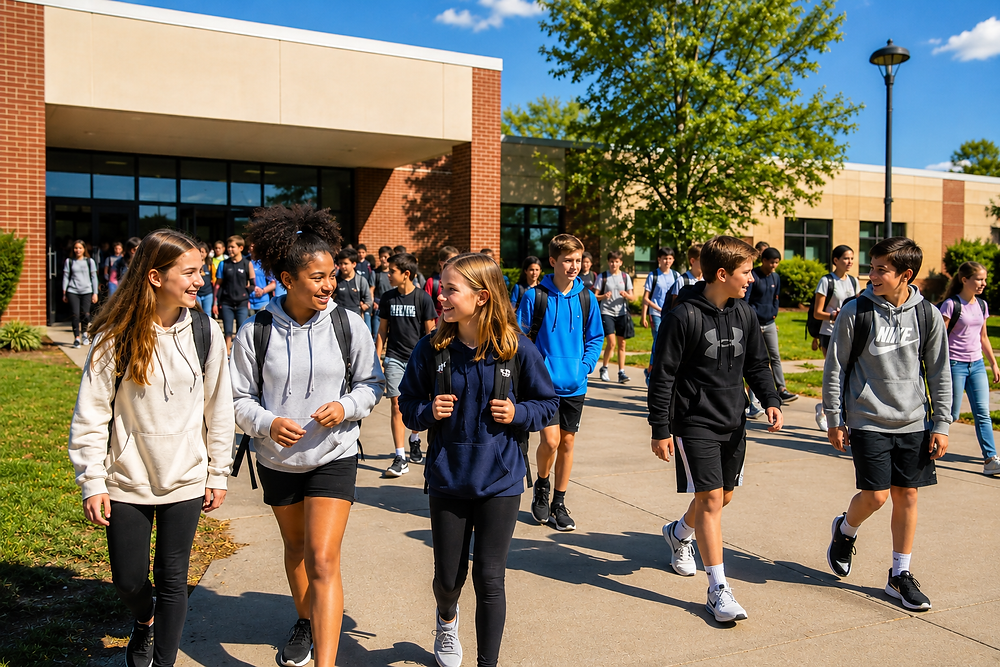
Evidence suggests that prolonged periods of uninterrupted classroom instruction can contribute to increased student distraction, behavioral problems, and classroom disruptions. Providing students with 10 to 15-minute outdoor breaks between classes may help improve focus, reduce behavioral issues, and better prepare students for the next instructional period.

The Delmarva Parent Teacher Coalition researched whether there is any merit to both the Board’s and Superintendent’s claims.

We found that Chairman Lankford’s effort to identify the causes of declining student achievement in Maryland and Somerset County has merit, particularly in examining the amount of time students are required to remain seated in structured classroom environments with limited opportunities for outdoor activity, movement, and mental reset after prolonged periods of instruction and Chromebook screen time.

There is substantial research— including systematic reviews, large-scale observational studies, experimental designs, and policy syntheses from the CDC and American Academy of Pediatrics (AAP)—showing that appropriate class durations, frequent breaks (especially outdoor ones with physical activity), and active breaks support student focus, attention, on-task behavior, and self-regulation across elementary through high school. https://pmc.ncbi.nlm.nih.gov/articles/PMC10189948/

Benefits are strongest and most studied in elementary school, but also extend to middle and high school with physical activity opportunities.

Recess and Outdoor Breaks with Physical Activity

Recess (typically 15–30+ minutes of unstructured or semi-structured outdoor play) and similar breaks consistently improve attention and classroom behavior. Key evidence includes:

• Elementary school studies:

• Jarrett et al. (1998): Fourth-graders were more on-task and less fidgety after recess compared to days without it. Hyperactive students benefited the most.

• Barros et al. (2009): In a large U.S. sample of ~11,000 third-graders, children with some daily recess showed better teacher-reported classroom behavior than those with little or no recess.

• Brez & Sheets (2017): Third- and fifth-graders demonstrated significantly better sustained attention (measured by letter-cancellation task) shortly after recess versus before it.

• Other observations: On-task behavior can increase dramatically post-recess (e.g., one small study showed improvement from ~37% to 70% after a 25-minute recess). Outdoor recess often outperforms indoor in reducing fidgeting and listlessness.

Broader reviews and syntheses (elementary focus, with extensions noted):

• Recess improves self-regulation, attention, on-task behavior, and classroom climate, which supports academic achievement indirectly.

• Outdoor/green or nature-based recess/play enhances these effects via Attention Restoration Theory (Kaplan): Natural environments help restore “directed attention” fatigue from classroom tasks. Studies show nature walks, green schoolyard play, or outdoor breaks improve working memory, selective attention, and sustained attention.

• Physical activity component adds benefits: Increased blood flow, neurotransmitters (e.g., dopamine, norepinephrine), and reduced sedentary time support cognitive function.

• Middle and high school: Traditional recess is rarer, but comparable daily physical activity breaks or opportunities yield similar benefits for attention and behavior. Reviews note positive effects for adolescents as well.

CDC and AAP guidance: Recommend ≥20 minutes of daily recess for elementary students and equivalent physical activity opportunities for older students. Recess is described as an “essential planned respite” that makes students more attentive and better able to perform cognitively afterward.

Outdoor settings provide extra value over indoor breaks alone due to nature’s restorative qualities.

Classroom Active Breaks and Class Duration

Frequent short active breaks (movement integrated into class time) and avoiding overly long unbroken instructional blocks also help:

• Systematic reviews on active breaks (classroom physical activity, typically 5–10 minutes):

• Positive acute (immediate) and some chronic effects on attentional outcomes: accuracy, concentration, inhibition, and sustained attention.

• Improvements in classroom behavior and time-on-task.

• Most effective breaks: Short duration (5–10 min preferred over longer ones), vigorous intensity, and activities with some cognitive demand (e.g., coordinated movements or games) rather than purely mechanical.

• One analysis: Students in classrooms with physical activity breaks were 75% more likely to meet daily activity recommendations and showed less off-task/inattentive behavior.

Class duration effects:

• Longer unbroken classes lead to more frequent attention lapses and declining focus over time.

• Segmenting instruction into shorter episodes with breaks increases effective “prime time” for learning and retention (aligning with primacy-recency principles).

• Frequent short breaks (even micro-breaks) help maintain consistent attention better than one long mid-session break.

• Models like Finland’s (short lessons with frequent outdoor/movement breaks) are often cited as supportive of sustained engagement.
These interventions show benefits without harming academics—and often improve the classroom environment, making learning time more productive.

Mechanisms and Considerations

• Physical activity: Boosts brain blood flow, supports executive function, and reduces restlessness.

• Breaks/outdoor time: Counters cognitive fatigue; nature adds restorative effects.

• Age differences: Elementary has the strongest recess-specific data. Middle/high school benefits more from structured active breaks or PE-integrated movement, though adolescents also gain from physical activity on cognition.

• Quality matters: Supervised, inclusive, safe recess with opportunities for vigorous play and social interaction yields better results. Poorly managed or sedentary “recess” is less effective.

• Limitations in evidence: Most studies focus on attention/behavior (strong positive effects). Direct academic achievement gains (e.g., test scores) are often indirect or mixed but generally supportive or neutral. Some individual studies show null results, but overall syntheses are favorable. Few large randomized trials exist for high school recess specifically.

The bottom line is that research strongly supports incorporating regular outdoor physical activity breaks and thoughtful class pacing (avoiding excessively long sessions without breaks) to enhance focus and attention from elementary through high school. These are low-cost, high-impact strategies endorsed by major health and education organizations. Schools can start with 15–20+ minute daily recess (elementary) or equivalent movement opportunities, plus short active classroom breaks.

For implementation details, see CDC’s Strategies for Recess in Schools or reviews on active breaks. Individual results vary by student needs, but the evidence base is robust and consistent.​​​​​​​​​​​​​​​​​​​​​​​​​​​​​​​​​​​​​​​​​​​​​​​​​​

1. Primacy Effect and Retention at the Start of Instruction

The primacy effect (part of the broader serial position effect) shows that people remember information presented at the beginning of a sequence or session better than material in the middle. This occurs because the brain has more cognitive resources available early on—short-term/working memory is less “crowded,” allowing better rehearsal and transfer to long-term memory. The recency effect boosts recall for items at the end of a session. https://thedecisionlab.com/biases/primacy-effect
Classic illustration (serial position curve):

Educational researchers, notably David A. Sousa in How the Brain Learns, apply this to classroom “learning episodes.” In a typical ~40-minute lesson, retention follows a pattern with:

• Prime Time 1 (first ~10–20 minutes): Highest retention. The brain is freshest; students absorb new or complex information best here (students are “like a sponge”).

• Down Time (middle portion): Lower retention for new material; better suited for practice, rehearsal, or processing what was already introduced.

• Prime Time 2 (last ~5–10 minutes): Another peak due to recency; ideal for closure, summarizing, or reinforcing key points.

For a 30-minute instructional block, the initial portion (especially the first 10–15+ minutes) represents a disproportionately effective window for introducing and retaining core content. Shorter focused episodes increase the relative percentage of “prime time.” https://dataworks-ed.com/blog/2014/08/the-primacyrecency-effect/

This is grounded in decades of serial position research (e.g., list-recall experiments) extrapolated to education. While some experts note the direct classroom evidence over full lesson lengths is more inferential than lab-based, the principle aligns with broader findings on cognitive load and memory encoding. https://www.learningandthebrain.com/blog/the-most-important-5-minutes-in-class-the-primacy-recency-effect/

2. Attention Spans and How They Interact with the First 30 Minutes

Children’s attention is more limited than adults’ and varies significantly by age, interest, activity type (passive lecture vs. active engagement), and individual factors (e.g., ADHD).

Common developmental heuristics (from childhood development experts):

• Roughly 2–5 minutes per year of age (or age + 1–2 minutes in some sources).

• Examples: A 5-year-old might sustain focused attention for ~5–15 minutes; a 7–8-year-old ~10–20+ minutes; older elementary students longer (20–30+ minutes for engaging tasks). These are averages—actual duration fluctuates.

https://www.brainbalancecenters.com/blog/normal-attention-span-expectations-by-age

Specific classroom evidence:

• One study of first graders found an average attention span of approximately 5–7 minutes during in-class activities.

• On-task behavior is higher during shorter instructional segments; it declines as activity duration increases (after controlling for factors like grade and format).
https://insightstobehavior.com/blog/managing-attention-in-the-classroom/

Attention lapses (Bunce et al., 2010, using clicker self-reports in chemistry classes—principles generalize):

• Lapses can begin as early as 30 seconds into a session.

• They occur in cycles that become more frequent/shorter as time progresses.

• Pure lecture leads to more lapses than interactive methods (e.g., questions, demonstrations).

• Students often re-engage quickly (lapses typically ≤1 minute), but overall sustained attention is not continuous.

https://www.academia.edu/29418572/How_Long_Can_Students_Pay_Attention_in_Class_A_Study_of_Student_Attention_Decline_Using_Clickers
Neural evidence supports this: Measures like EEG alpha power (indicating attention) correlate with better immediate and delayed retention. Group neural synchrony with the teacher or content also predicts learning outcomes. https://pmc.ncbi.nlm.nih.gov/articles/PMC12384261/

Key takeaway for the first 30 minutes: Attention and retention potential are typically highest at the very start (aligning with primacy). They tend to fluctuate or decline (more so in younger children or during passive delivery) as the session continues within that window. Active, varied, multisensory instruction helps sustain focus longer than traditional lecturing.

Practical Implications from the Research
To maximize learning and retention in the first 30 minutes (and beyond):

• Front-load key content — Introduce the most important or novel material early (Prime Time 1).

• Use an engaging hook or objective at the start to capitalize on initial attention.

• Incorporate active learning (discussions, hands-on tasks, clicker-style questions, movement) throughout to reduce lapses.
• Use the middle portion for practice/rehearsal rather than new input.
• End with quick closure or review.
• For younger children or longer blocks, build in short movement/brain breaks—these align with attention restoration principles and improve on-task behavior.
• Shorter, focused instructional segments are generally more efficient
Main sources include cognitive psychology (serial position effect), David Sousa’s synthesis of brain research for educators, classroom observation studies (e.g., on-task behavior in elementary grades), and attention research like Bunce et al. (2010).

Somerset County’s active debate shows a helpful and targeted focus on key reasons why students have trouble learning and keeping focus and attention.

Chairman Lankford’s proposal would not only benefit students, but also the teachers who often become target of student rage, boredom and behavior problems.

The Somerset Educators Association would benefit from supporting the Board’s and specifically Chairman Lankford’s efforts to promote student achievement, school safety, and a more productive learning environment by implementing shorter instructional periods and a year-long curriculum model, rather than relying on 90-minute block scheduling and expecting teachers to teach an entire year’s worth of mathematics in a single semester.
The Somerset County Board of Education is taking a leadership role in addressing the root causes of student achievement and growth challenges, which is something that the Maryland Blueprint actually requires.
Fellows & Editors

June 27, 2026

Please consider supporting or signing up to the Delmarva Parent Teacher Coalition and follow us on facebook to stay informed of what’s really happening with education in our schools.


top of page

bottom of page


45Minute breaks classes Classroom extended Learn Outdoor Students time
Share. Facebook Twitter Pinterest LinkedIn Tumblr Email
info
Delmarva Parent Teacher Coalition
  • Website

Related Posts

Social Security Trust Fund Projected to Run Dry by 2032, New Trustees Report Warns

9 June 2026

Judge Strikes Blow For Transparency In Baltimore City

4 June 2026

Mother Files Lawsuit Alleging That Baltimore County Public Schools Drugged Her Non-Verbal Autistic Son

26 May 2026
Leave A Reply Cancel Reply

Don't Miss

Do Students Learn Better with 45-Minute Classes and Outdoor Breaks or Extended Time in the Classroom?

Editorials 29 June 2026

Somerset County Board of Education Chairman Matt Lankford brought to light yet another major educational…

Worcester County Sheriff’s Office satisfied with budget implementation

14 June 2026

The Scandal Behind the Scandal: Is the Real Battle the Race for Wicomico Sheriff?

11 June 2026

Fox 45 Reporter Gary Collins Presses Wicomico County Executive About Nude Photo Allegations

10 June 2026
Stay In Touch
  • Facebook
  • Twitter
  • Instagram

Subscribe to Updates

Subscribe to our newsletter and stay updated with the latest news and exclusive offers.

Subscribe

* indicates required
/* real people should not fill this in and expect good things - do not remove this or risk form bot signups */

Intuit Mailchimp

Categories
  • Delaware (27)
  • Eastern Shore (1)
  • Editorials (270)
  • Maryland (90)
  • Politics (42)
  • Public Safety (11)
  • Satire (15)
  • Somerset (35)
  • State (2)
  • Uncatgorized (11)
  • Virginia (28)
  • Wicomico (62)
  • Worcester (31)
About Us
About Us

At Delmarva Times, we are committed to delivering timely, accurate, and insightful journalism that serves the diverse communities of the Delmarva Peninsula. Our dedicated team of reporters, editors, and contributors are passionate about providing in-depth coverage of local events, issues, and stories that matter most to our readers.

Facebook X (Twitter) Instagram
Trending

Misuse of School Funds Raise Serious Questions of Oversight in Worcester County

14 April 2026

Parrott Congressional Race In Maryland One Of Five Most Important In The Country For Republicans

7 September 2024

Somerset County Public Schools Spent $286,000 on Conferences in 2023

15 December 2023
New Comments
    © 2026 Delmarva Times. All Rights Reserved.
    • About Us
    • Contact Us
    • Privacy Policy
    • Terms and Conditions

    Type above and press Enter to search. Press Esc to cancel.