

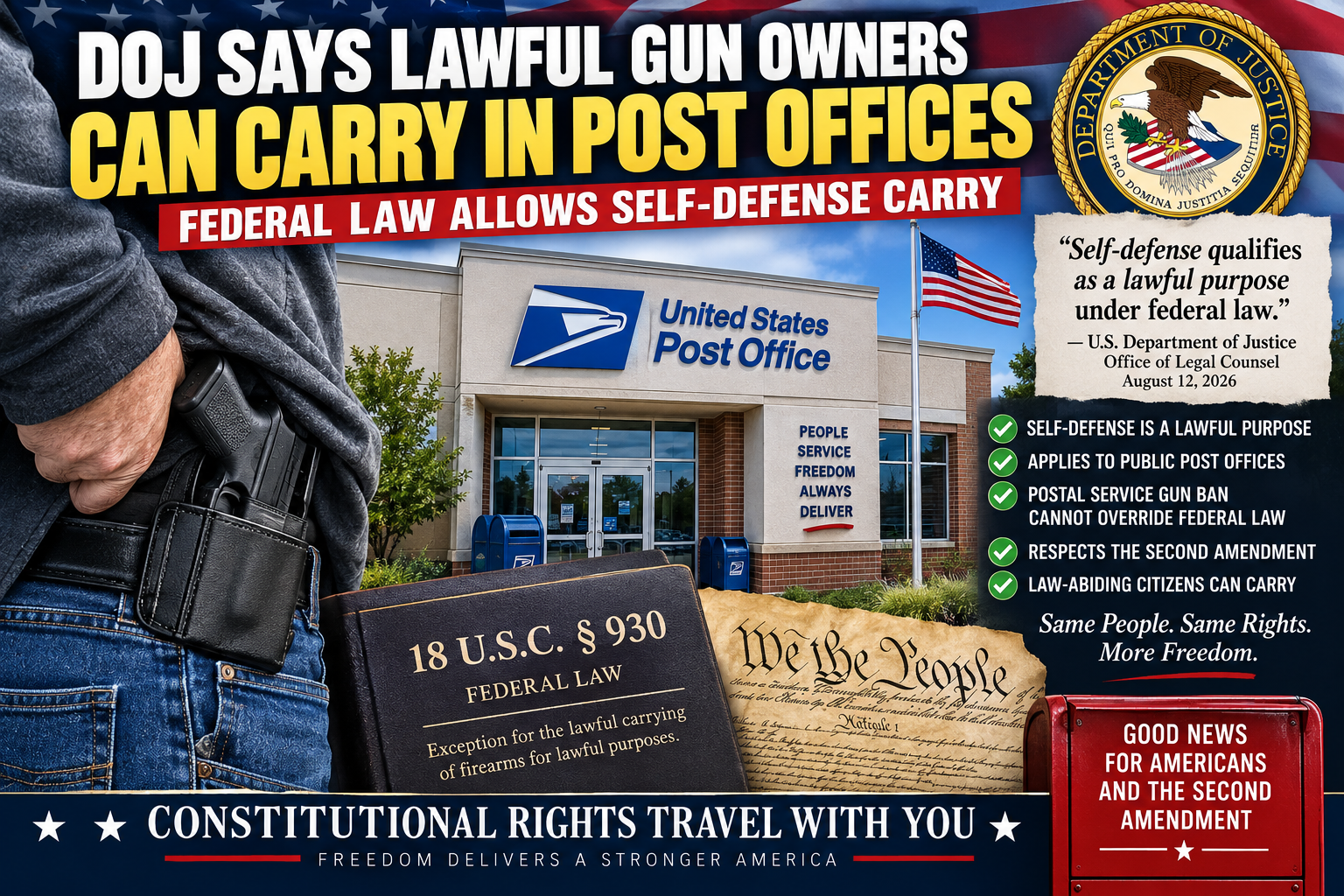
Justice Department says federal law allows lawful self-defense carry in post offices open to the public
For decades, Americans have generally been told that carrying a firearm inside a U.S. Post Office was prohibited under federal law. A new legal opinion from the U.S. Department of Justice is challenging that long-standing interpretation.
On August 12, 2026, the Justice Department’s Office of Legal Counsel (OLC) issued an opinion concluding that federal law permits an otherwise law-abiding person to carry a constitutionally protected firearm into a post office that is generally open to the public when the firearm is carried for self-defense.
The opinion centers on 18 U.S.C. § 930, a federal statute that generally prohibits firearms in federal facilities. However, the statute contains an exception for the “lawful carrying” of firearms in a federal facility when connected to “hunting or other lawful purposes.”
According to the OLC, self-defense qualifies as a lawful purpose under that exception.
DOJ Says Self-Defense Is a Lawful Purpose
The Justice Department’s analysis distinguishes between someone who is legally prohibited from possessing a firearm and an otherwise law-abiding citizen carrying a firearm for self-defense.
The OLC concluded that a person who may lawfully possess and carry a firearm and who enters a post office open to the public while carrying for self-defense falls within the statutory exception.
The opinion points to Supreme Court precedent recognizing self-defense as central to the Second Amendment and notes that post offices open to the public function much like other businesses people routinely enter during their daily lives.
The DOJ opinion states that the exception in federal law therefore permits the lawful carrying of constitutionally protected firearms in public post offices.
What About the Postal Service’s Own Gun Ban?
The issue goes beyond the federal statute.
The U.S. Postal Service has its own regulation, 39 C.F.R. § 232.1(l), which generally prohibits carrying or storing firearms and other dangerous weapons on postal property, except for official purposes.
The Justice Department concluded that this regulation cannot override the exception Congress included in federal law.
Because the Postal Service regulation does not contain a comparable exception for lawful self-defense carry, the OLC concluded that the regulation is unlawful as applied to otherwise law-abiding citizens carrying constitutionally protected firearms for self-defense in post offices open to the public.
The DOJ subsequently notified Congress that it would dismiss its appeal in litigation challenging the post-office firearms restrictions. The department cited its OLC opinion and stated that the federal statute’s lawful-purpose exception permits self-defense carry in public post offices.
This Does Not Mean Every Federal Facility Is Now Open to Firearms
There are important limitations.
The DOJ opinion concerns post offices that are generally open to the public and otherwise lawful possession and carry for self-defense. It does not establish a blanket rule allowing firearms in every federal building.
State laws also remain relevant. Whether a person may lawfully possess or carry a firearm can depend on state licensing requirements, prohibited-person restrictions and other applicable laws.
The opinion also does not mean that every sign or restriction at every postal facility has necessarily been physically removed.
DOJ Opinion Is Not the Same as a Supreme Court Ruling
Another important distinction is that the OLC opinion is an interpretation of federal law by the executive branch. It is not a new Supreme Court decision and does not itself amend the U.S. Code.
However, it represents a significant change in the federal government’s interpretation of the existing law.
The Justice Department’s position is that Congress already created an exception in § 930 for lawful firearm carry for lawful purposes and that self-defense falls within that exception when an otherwise law-abiding citizen enters a public post office.
The department further concluded that the Postal Service cannot use its own regulation to eliminate an exception that Congress established by statute.
What the New Position Means
The practical significance of the DOJ opinion is substantial: according to the Justice Department, the federal government may not enforce 18 U.S.C. § 930(a) or the Postal Service’s firearms regulation against an otherwise law-abiding individual who carries a constitutionally protected firearm into a public post office for self-defense.
The development follows federal litigation in which restrictions on firearms in post offices were challenged under the Second Amendment. The government later moved to dismiss its appeal, leaving an injunction protecting the plaintiffs and covered members of the organizations involved in that case.
For gun owners, the issue has therefore moved well beyond a simple question of whether a “No Firearms” sign is posted on a post office door. The current federal position is based on the language of federal law, the statutory exception for lawful purposes and the Justice Department’s interpretation of the Second Amendment.
Bottom line: The Justice Department now says that an otherwise law-abiding person carrying a constitutionally protected firearm for self-defense may lawfully enter a post office that is generally open to the public, and that the Postal Service’s broader firearms prohibition cannot be enforced against such a person under the circumstances described in the opinion.
